I was just talking to Vatsal. He asked me what I am building these days. I told him I am building Tow and Pooler.
Tow lets me run coding agents on different computers and repositories from one place without losing their sessions. Pooler sits between AI clients and model providers. It handles all their weird protocols, accounts, routing, retries, and streaming in one place. Pooler will be much, much better than the proxies people use right now.
He said, “This is all good, but a good heuristic of a good problem would be if it takes you a lot of time and effort to build.”
Vatsal was right. I can see a problem, find the solution instantly in my mind, and solve it within days. That problem is not taking everything out of me. I am wasting myself if I make it the company. There are a million problems in the world. I am capable of solving them all, but do I have to solve them all? No.
I got incredibly frustrated with myself when I realised this. I was like, “Oh shit, what the fuck am I doing?”
I needed to detox myself, so I started listening to this song, and it has these lyrics:
the VCs are backing
baby, let’s get cracking
blog blog blog it all
blog it if it’s big or small
blog at the cineplex
blog while you’re having sex
blog in the locker room
babies blogging in the womb
blog even if you’re wrong
won’t you blog about this song?
So I thought I need to write a blog to explain my situation.
Mony and I had already decided that I would not stick to one project idea right now. We made that decision together because we have been trusted with the time to explore everything and find the best thing we want to work on. Mony wants me to keep building all of these things. The first project that excites me for a week does not automatically become the company.
I will keep working inside the company every day while we explore. I want to build things. Side projects are part of that. Vercel does shitloads of stuff alongside its main product. Making more things does not damage the company.
Tow and Pooler have a ridiculous amount of engineering inside them. Both can become very useful. At the scale of what Mony and I want to build, they are still side projects. It is not a matter of users. A project can have a lot of users and still be the wrong thing for me to spend the next ten years on. It can also have almost no users right now and contain the beginning of something huge. The number does not answer the question.
There are a thousand great ideas I can work on. Most of them would get into YC. Most of them would raise money. I can build something useful, get users, and turn it into a good business. That is not why people backed us. It is not what Mony and I have promised ourselves.
We have promised this to our investors and to ourselves. We have promised it to ourselves for our whole lives. We are going to build something generational. Another dev tool that gets users and eventually becomes a good company does not fulfil that promise. Another simple thing that raises another round does not fulfil it either.
A generational company happens once in a decade. Last decade it was OpenAI. Before that it was Palantir. Before that it was Google. Before that it was Microsoft. These companies changed what everyone else built after them.
We want to be the next company on that list. A smaller company can still get funded. It can get into YC. It can get millions of users. It is still smaller than what we promised to spend our lives building. We are not here to make some fucking small SaaS.
I have no idea how to find an idea.
Every good idea I have ever had came from one of my own problems. I built ArcXiv because I wanted to read papers and hated the way I had to do it. Tow came from having coding agents running everywhere and wanting one place where I could see them, talk to them, and keep their work alive. Pooler came from dealing with AI clients and model providers that all speak slightly different languages and having to build another bridge every time two of them need to talk.
I never sat down and decided that I would now perform the official process of finding a problem. I got annoyed. The annoyance stayed. Eventually I started building.
Now I am trying to deliberately produce something that has only ever happened to me by accident. I have no idea how to do that.
I genuinely do not think any great idea has been found intentionally. Every great invention was an accident. People were doing something, something weird happened, and one person paid attention. Or they kept facing the same problem for years until they finally got angry enough to solve it.
People work insanely hard, learn everything, run experiments, and build things. The idea appears somewhere inside all that work. I do not think anyone sits down at 4 p.m., thinks very hard, and discovers the thing that changes the world by 6 p.m.
If Mony and I waste our time sitting in a room and thinking of ideas like idiots, nothing will work out. We will definitely produce ideas. I can produce ten ideas in an hour. I can also convince myself that all ten are huge. That is exactly why this is dangerous for me.
If everybody already agrees that a market is important, hundreds of people are already thinking about it. If a public framework sends a thousand founders towards the same problem, all thousand will arrive and pretend they discovered it. Now you have a race. You have not found something new.
A genuinely new idea looks stupid at first. Otherwise somebody would already be doing it. It looks like a toy. It looks too small. It is a problem that everyone has accepted because they assume the world simply works that way. Then one person refuses to accept it and suddenly there is a company.
I cannot search for a thing I do not know how to describe. I will keep doing stuff and pay attention when a problem keeps coming back.
Tow and Pooler are how I search. They put me next to real agents, protocols, providers, accounts, failures, and people trying to use the things. Every week of building exposes another problem. A blank Notion page called "startup ideas" exposes nothing.
I know my own failure mode. I get attached to anything I build. Once I have made the product and people start using it, I can find a hundred reasons why it should be the company. I am very good at falling in love with my own work. That makes the decision harder. The project itself has to prove that it deserves the next ten years.
Whenever I tell people I am looking for an idea, somebody gives me something to read. Read this essay. Use this framework. Pick an industry. Find the painful workflows. Speak to people. Write everything down. Score the problems. There is always a process waiting for me.
School was exactly like this. If you wanted to understand something, there was a chapter to read before the chapter you actually cared about. Then there was an exercise, then another exercise, and eventually you would be allowed to touch the interesting thing. There was always a correct route to curiosity.
I like process. I like discipline. I like waking up and doing the work even when I do not feel like doing it. Using somebody else's process to decide what I should care about feels forced. It feels like bullshit.
The moment I make "find an idea" into a task, I can complete the task without finding anything. I can generate markets. I can list problems. I can make almost any idea sound important if I think about it for long enough. Then I can build the first version quickly, which makes it feel even more real. A working product is very persuasive, especially when you are the person who made it.
This is why Vatsal's point frustrated me so much. Tow and Pooler have a lot left to build. I can already see their shape. I can see most of the route from here to the thing I want. That is usually the part I enjoy. I disappear for a few days, learn whatever I need, and return with the software.
The company will ask more from us. We are looking for a problem whose route is invisible on the first day, one that forces Mony and me to become much better and keeps producing harder problems after the obvious ones are gone. We will solve it. First we have to find it.
The side projects are part of looking. Sitting in a room and thinking very hard has never given me anything. Building puts me close to actual constraints. I find weird protocol failures, missing tools, people using things in ways I did not expect, and problems hidden behind the problem I thought I was solving. Each project gives me another surface to get annoyed by.
This is my process: keep building without lying to myself that every build is the company.
-
01 I wrote
“I genuinely do not think any great idea has been found intentionally. Every great invention was an accident.”
-
02 Aryaman asked
“Imagine one of those ideas is the seed of something generational. Would you realise it, or would it become one of the ten things you write down and discard in an hour? How would you know?”
-
03 I think now
“An idea only needs enough interest for me to test it. Complete conviction can come later.”
That question got stuck in my head. I sent him a couple of answers the next morning while I was half asleep. He had already read them. I deleted them because they sounded like shit and I did not agree with what I had said.
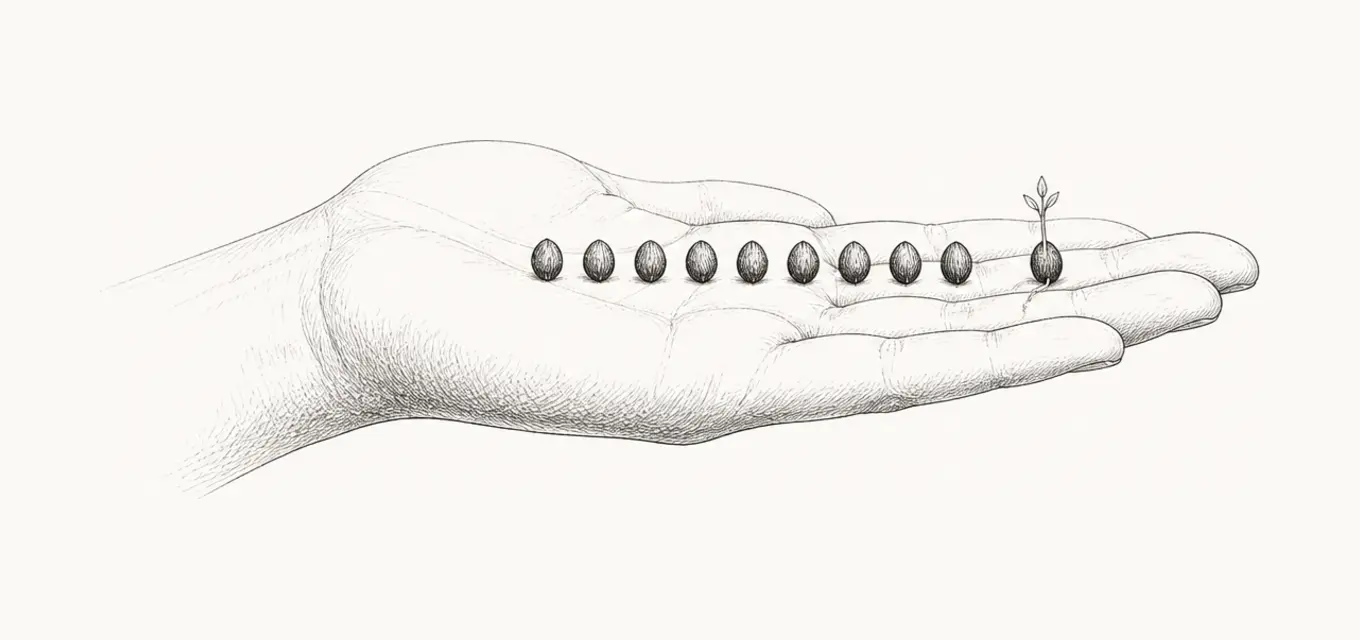
I spent the entire day looking for an answer. What if I already have the seed of a generational company? What if I have the idea and do not have conviction on it yet? What if it looks like another small tool, so I throw it away before understanding what it could become?
I read Paul Graham's How to Get Startup Ideas. He describes an initial idea as a question you start answering. The company changes while you work on it. The first idea gets you close enough to the problem to find the real one.
Then I realised I already do this. If I get ten ideas, I do not build all ten. I pick the best two and build them. I do not permanently discard the other eight because of one hour of thinking either. I keep them. I can return when I know more.
Building gives me something real to judge. Most ideas become smaller once I understand them. I see the product, build it, and find the ceiling. A few ideas keep getting larger. Every answer exposes another problem. People pull the product somewhere I did not expect. That is where conviction comes from.
Tow and Pooler are both being tested this way. I am building them far enough to see what is actually there. If either one contains the seed, I am not going to lose it because I failed to feel ten years of conviction in the first hour.
I understand what Vatsal said differently now. Version one can be easy. The real problem can keep demanding more from us for years.
Finding an idea like this is hard. Good. A generational company should take more than an afternoon staring at a Notion page. We have been given the time to explore properly. We are going to use all of it.
I know what Mony and I can do. We learn insanely fast. We build insanely fast. We have the best people around us. People backed us pre-idea because the bet was on us. They were right.
The hard part is choosing a problem worthy of that hand. We are not lowering the standard because an easier idea could get funded, get into YC, or get users. We will keep building and keep looking until we find the thing that deserves the next decade of our lives.
I do not know the name of the company yet. I know exactly what happens when we find it. We will fucking win.